British No. 9 Mk 1 Bayonet
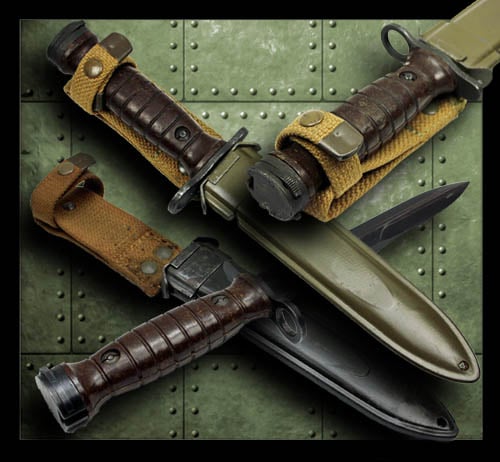
The British No. 9 Mk 1 bayonet was a post-WWII socket bayonet designed to replace the unpopular No. 4 "spike" bayonets used on the Lee-Enfield No. 4 rifle. It famously "married" the socket of the spike bayonet with the bladed edge of the No. 5 Jungle Carbine bayonet, resulting in a much more effective Bowie-style blade.
Key Specifications
- Fits: Lee-Enfield No. 4 rifle (all variants) and the Mk 5 Sten gun.
- Blade: 202mm (approx. 8 inches) blued steel blade with a rounded spine, deep fuller (blood groove), and sharpened clip point.
- Scabbard: Uses the same scabbard as the No. 5 and No. 7 bayonets.
- Production Period: Formal approval was granted in 1948, though production started as early as 1947 and continued until 1962.
Manufacturers & Markings
Over 500,000 units were produced by several factories, each using distinct markings:
- ROF Poole (1947–1949): The earliest producers, marked with a "P" inside a circle and the year. They made approximately 200,000 units.
- RSAF Enfield (1949–1962): The primary manufacturer, marked with a superimposed "ED" (Enfield) and a two-digit year (e.g., "-51"). They produced roughly 377,000 units.
- Minor Manufacturers: Smaller batches were made by:
- Francis Francis and Barnet Ltd: Marked with "M49".
- Biffords Ltd: Marked with "M50".
- Jeep Buggins and Company Ltd.
Historical Context
While the Army moved toward the SLR rifle in the late 1950s, the No. 9 bayonet remained in service for decades. It was notably used by the Royal Navy, which kept the No. 4 rifle longer than the Army, and saw action with Royal Marine Commandos during the Suez Crisis.