

U.S. M-1910 Pickaxe
The US Model 1910 "Pick Mattock" is an iconic entrenching tool used by the US Armed Forces during World War I, World War II, the Korean War, and well into the 1970s. It was designed to break through hard soil, tree roots, and rocks where a standard entrenching shovel (such as the well-known T-handle shovel) fell short.
Design and Specifications
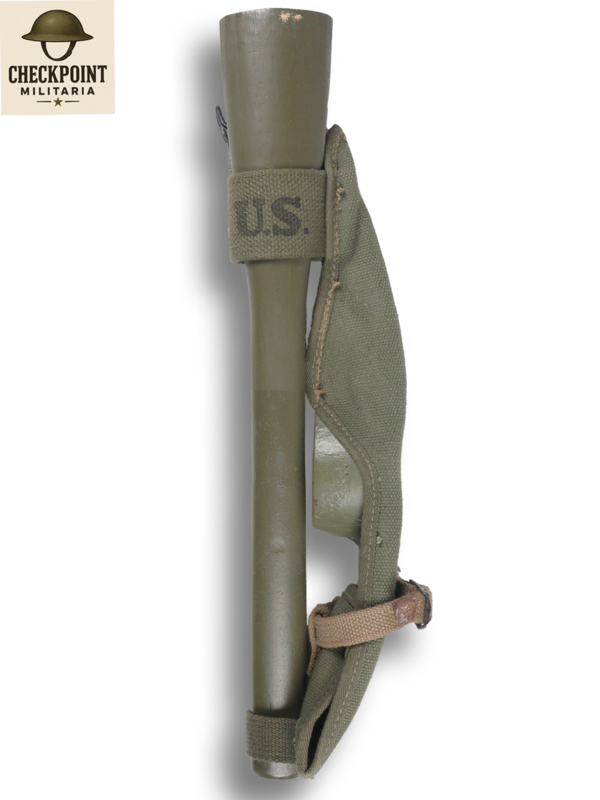
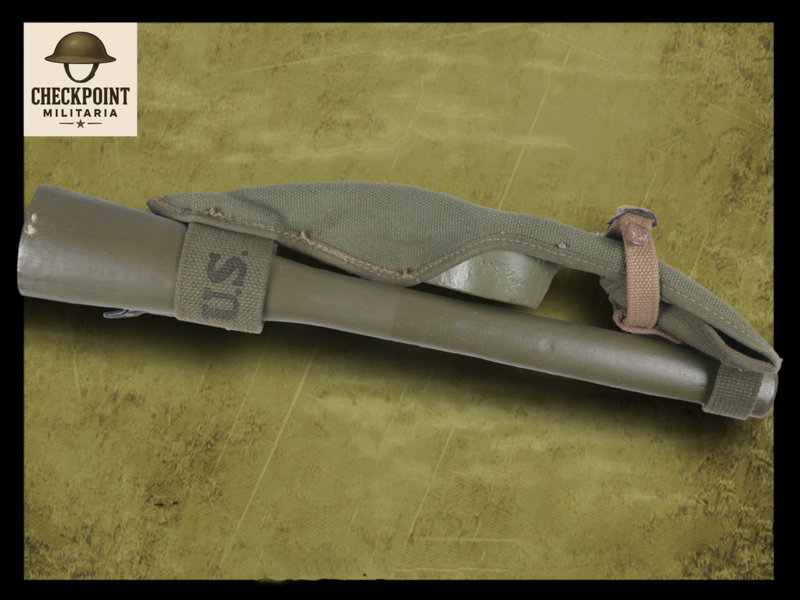
The tool is distinguished by its clever, two-piece collapsible construction, allowing it to be compactly carried on a pistol belt or backpack.
- The Head (Dated 1944): Made of forged steel with a length of approximately 13 to 13.5 inches (approx. 33 cm). The head is dual-sided: one side features a sharp, pointed pick, while the other side has a flat, wide adze/mattock blade.
- The Handle: A separate, tapered wooden shaft (usually made of ash or hickory) with a length of approximately 17 inches (approx. 43 cm). By sliding the handle through the eye of the head, the head wedges itself firmly into place using gravity and centrifugal force during use.
- Weight: The complete tool weighs approximately 2.5 pounds (approx. 1.1 kg) when assembled.
- The Carrier (Dated 1945): The set was stored in a canvas M1910 carrier equipped with the standard double metal wire hook. The bottom of the carrier featured an opening through which the wooden handle protruded.
Differences Between WWI and WWII Models
There are clear differences to look out for when identifying early versus late production models:
- World War I (and pre-WWI): These early examples feature a completely bare, unvarnished wooden handle and an unpainted steel head. Both the head and the handle are marked only with a simple "U.S." stamp, without a production year or manufacturer's name.
- World War II: Starting in this period, the heads and handles were coated in Olive Drab (OD) paint. Additionally, the heads were stamped with the production year (e.g., 1943 or 1944) and the manufacturer's name (such as Diamond Calk Horseshoe Co., Plumb, or Warwood).
Military Deployment in the Field
Within an infantry unit, the pick mattock was not issued to every soldier. According to US Army regulations, an average of 2 to 3 men per rifle squad carried a Pick Mattock instead of a regular shovel. They were responsible for the initial heavy breaking of the ground when digging a position or trench, after which the rest of the squad could clear the loosened soil with their shovels.