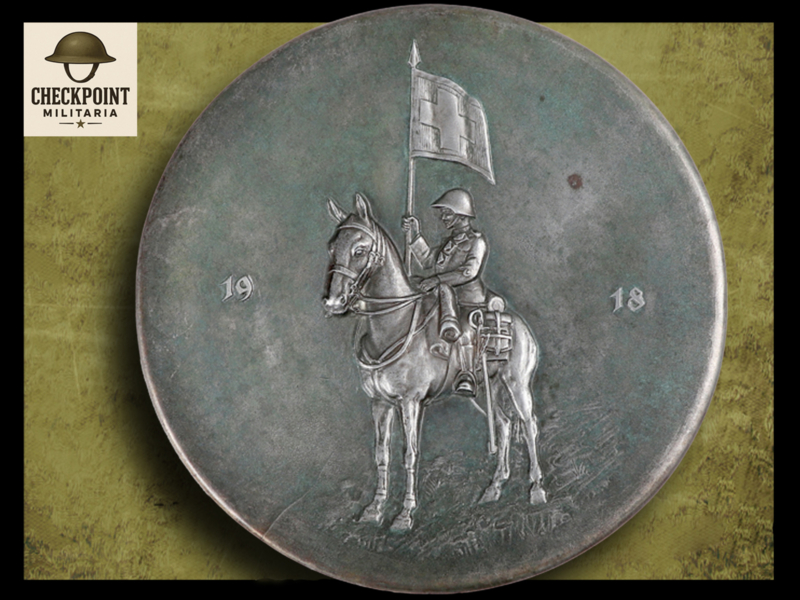


Swiss Bronze Relief 1918 with a Diameter of 25 cm.
The Border Mobilization 1914–1918 (the border guarding during the First World War) was a defining chapter in modern Swiss history. Although Switzerland remained strictly neutral, the country had to continuously protect its borders militarily against the warring superpowers surrounding it.
The tradition of commemorative plaques and other memorabilia from this period features a number of specific characteristics:
The Military Context: Active Border Guarding
- Mass mobilization: Right away in August 1914, Switzerland mobilized more than 200,000 soldiers within a few days under the leadership of General Ulrich Wille.
- Harsh conditions: The soldiers (including the cavalry or Kavallerie) spent years in trenches and guard posts in the Alps, often under miserable and freezing conditions.
- Economic sacrifices: At the time, soldiers received barely any pay, and there was no compensation for lost income. This caused great poverty among the families left at home.
Why these commemorative plaques?
When the war ended in November 1918, the army returned home. Because there was little financial aftercare or official medals provided by the government at the time, a huge demand arose for tangible keepsakes to honor the sacrifices of the troops.
- "Dienstzeit-Urkunden" and reliefs: Thousands of commemorative plaques (made of bronze, tin, or ceramics) and beautifully illustrated certificates were produced. They served as proof that the soldier had fulfilled his duty to the homeland (Heimat).
- National pride: The image of the Swiss cavalryman on this plaque symbolized vigilance, mobility, and the defense of Swiss sovereignty at the time.
- Corporate sponsorship: Companies such as Umbehr A.G. supported this culture of remembrance. They did this out of patriotism, but also to honor their own employees returning from the front, or to give as gifts to business relations as a sign of solidarity. Such a plaque would hang prominently in the veteran's living room back then.