German Foldable Goggles "Wehrmacht Augenschützer M1942"
The Wehrmacht Augenschützer M1942 (better known as the Augenschützer 42 or Staubschutzbrille) is the disposable, folding dust goggles introduced by the German army in 1942. This lightweight eyewear was developed to meet a major need for inexpensive, easy-to-produce eye protection. It grew to become a standard piece of equipment on all fronts of the Second World War.
Key Features and Design
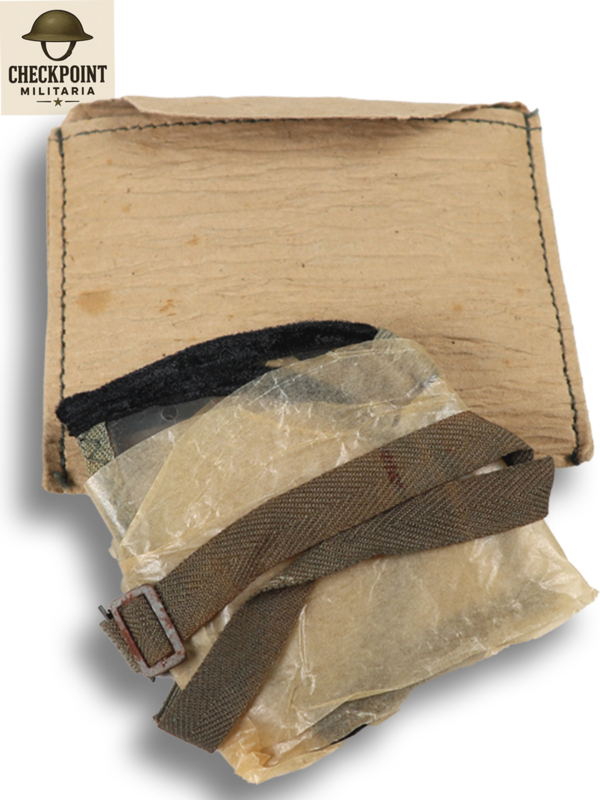
- Materials and construction: The goggles were made of flexible plastic or Perspex (cellophane)lenses. Unlike heavier military goggles, this model had a striking four-panel folding design held together by pieces of cloth. This allowed the goggles to be folded completely flat.
- Comfort and fit: The edges of the plastic lenses were usually finished with a soft trim of black velvet or felt to protect the face. The goggles were held in place by a simple elastic or fabric headband.
- Two main variants:
- Clear lenses: Issued for general protection against dust and wind.
- Tinted/brown lenses: Issued for protection against the bright sun in extreme environments, such as the deserts of North Africa or snowy landscapes.
- Packaging: The goggles were usually supplied in a simple paper or cardboard envelope. Sometimes they were delivered as a set of two (one clear and one tinted) in a small cloth pouch, featuring a military quality stamp (Waffenamt / WaA).
Wartime Use
Although the goggles were originally conceived as a basic protection against chemical combat gases, in practice they were mainly used against weather conditions. The goggles were widely deployed by the Deutsches Afrika Korps (DAK) to brave the fierce sandstorms in the desert, and by motorized units and infantry on the dusty Russian steppes of the Eastern Front.