

Pilot's Notes Lysander Dated: 1941
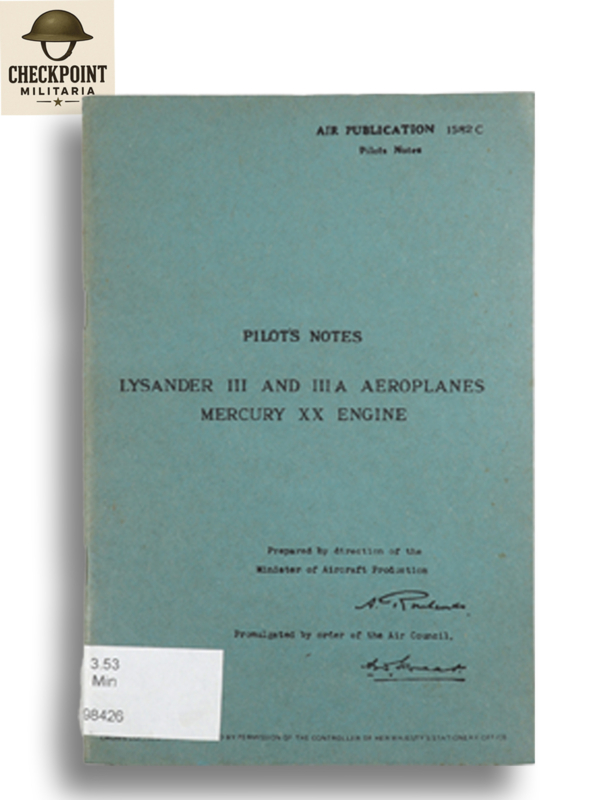
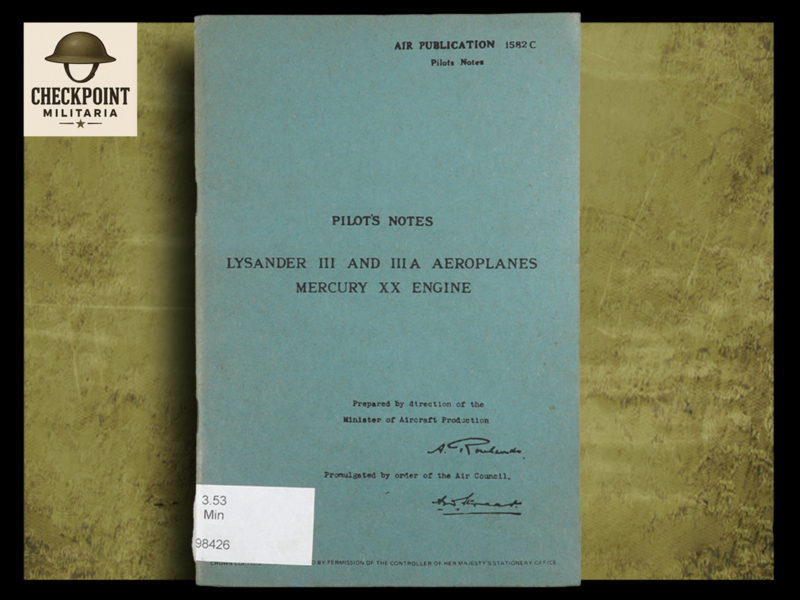
"Pilot's Notes" for the Westland Lysander refers to the official Air Ministry handling manuals (specifically Air Publication 1582C) issued during the Second World War. These manuals helped pilots manage the unique, highly demanding cockpit layout and flight characteristics of this legendary STOL (Short Takeoff and Landing) aircraft.
The technical specifications and notable characteristics from these historical documents highlight why the Lysander was both a mechanical marvel and a challenge to fly:
Cockpit & Systems
- Pneumatic Braking System: Equipped with a distinct British brake pressure gauge. The outer needle indicates total pneumatic system pressure, while smaller internal needles show left and right wheel pressure individually.
- Ground Steering: The aircraft lacks steerable tailwheel control or toe brakes. Pilots use a hand lever (similar to a bicycle brake) on the control column to activate the brakes for ground turns.
- Airspeed Indicator: The dial rotates twice; the outer ring goes up to 200 mph, while higher speeds are read on an inner ring.
- Propeller Control: Operates via a simple pitch position selector. The pilot pushes the lever forward for fine pitch (takeoff) and pulls it back for coarse pitch (airborne cruising).
- Fuel Monitoring: Because the fuel tanks sit directly behind the pilot's seat, a built-in mirror is mounted so the pilot can indirectly read the otherwise invisible fuel gauge.
Flight Characteristics and Control
- The Infamous Tail Trim: The Lysander utilizes a fully moving tailplane assembly rather than a traditional trim tab. To transition from the full nose-down position to the nose-up position for takeoff, the pilot must turn a large cockpit trim wheel 16 full rotations. This was a demanding and risky task during high-workload operations.
- Automatic Slats and Flaps: The aircraft features mechanically linked, automatically operating trailing-edge flaps and leading-edge slats. These deploy entirely on their own based on airflow and airspeed to prevent stalling during slow maneuvers.
- Extremely Low Stall Speed: Thanks to its high-lift wings, the Lysander boasts a remarkably low stall speed of roughly 56 to 60 mph (approx. 90-95 km/h). This made the aircraft ideal for secretly dropping Special Operations Executive (SOE) agents into small, unlit French clearings.
- Hot Cockpit Environment: The engine oil tank and coolers are mounted right behind the instrument panel near the pilot's legs without heavy insulation. As a result, temperatures inside the cockpit could rise drastically during flight.