

French WW1 Flag Pole Finial - Third Republic RF Spear
During the French Third Republic (1870–1940) and specifically the period of the Great War (1914–1918), the French flag pole finial (fer de lance) underwent strict standardization. Following the fall of Napoleon III and the Second Empire, the imperial eagle was resolutely abolished and replaced by a republican symbol.
Design and Characteristics (1870–1918)
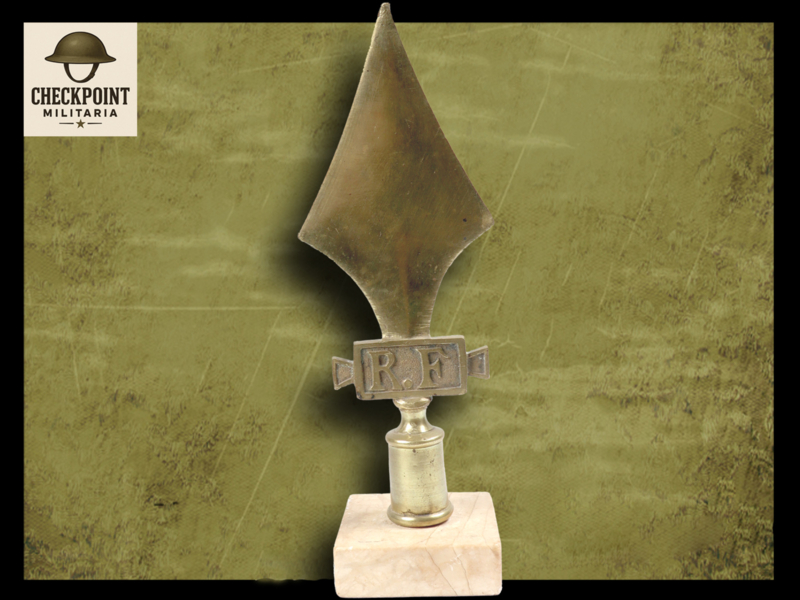
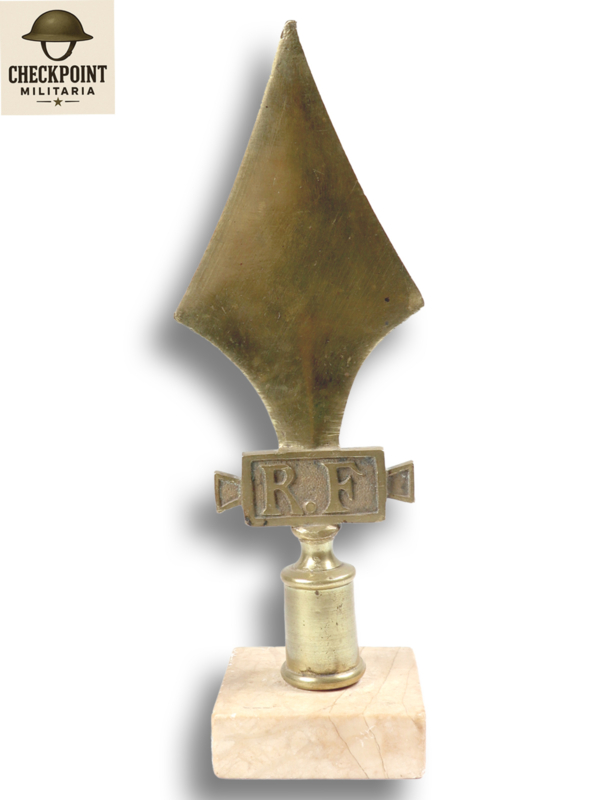
- The "RF" Monogram: The most crucial feature of this specific period is the rectangular center section. This is adorned on both sides with the letters "RF", which stands for République Française (French Republic).
- Material: The finials were cast from high-quality brass (laiton) or bronze. For official regiment flags and high-end parade finials, this brass was often heavily gilded.
- Shape: The finial has the shape of a stylized lance head or spearhead (fer de lance). The base extends into a hollow socket (the fitting) with which the finial was slid over the wooden flagpole (hampe) and secured with screws or pins. The total length of the finial usually varies between 25 and 30 centimeters.
Variants from the First World War
Although the basic design was uniform, historians distinguish between three main types from the 1914–1918 period:
- Military Regiment Finials: Plain, sturdily cast brass examples. These were purely functional, intended for the combat flags of the infantry, cavalry, and artillery at the front.
- Official Institutes & Firefighters (Sapeurs-Pompiers): Often beautifully gilded, sometimes decorated with subtle extra elements at the base of the lance (such as oak or laurel leaves, symbols of steadfastness and victory).
- Local Patriotic Associations: During the war, many local civic guards or support committees were established, flying their own flags featuring similar RF finials.