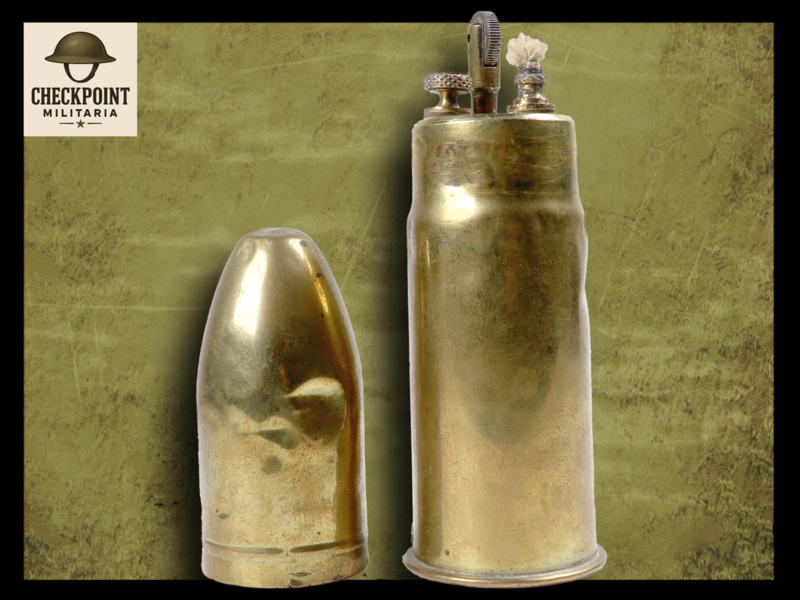


French WWI Hotchkiss 37mm Pom Pom Lighter
A rare WWI Hotchkiss 37mm Pom Pom lighter is military memorabilia in the style of trench art. It uniquely bridges the industrial-technical exhibitions of the late 19th century and the frontline logistics of the First World War.
Historical Context & Origin
- The 1889 Paris Exposition: This object was originally produced as a high-quality factory demonstration piece for the 1889 Exposition Universelle in Paris. This event is most famous for introducing the Eiffel Tower.
- The "Ministry of Finance" Designation: In France, these types of lighters are historically often referred to as "Ministry of Finance" lighters (briquet du Ministère des Finances). This is because automatic lighters and matches were heavily taxed by the French government at the time. To prove that the tax had been paid, an official registration stamp or plate was authorized by the French Ministry of Finance and applied directly to the lighter.
- The Manufacturers: The lighter utilizes a replica of the 37mm "Pom Pom" casings designed by Hotchkiss & Co. The object features official markings from the Société Française des Munitions (S.F.M.) based in Paris, the most prominent private French ammunition manufacturer of that era.
The Legacy of the 37mm Pom Pom
The 37mm caliber replicated by this lighter is legendary in military history:
- The "Pom Pom" Nickname: Originally designed by Benjamin Hotchkiss in the 1870s/1880s, these early rapid-fire automatic and revolving cannons earned the nickname "Pom Pom" due to the distinctive, rhythmic, thumping sound they made when firing.
- WWI Service: Although the concept dates back to the late 19th century, the 37mm caliber was widely deployed during the First World War. The French military relied heavily on 37mm guns (such as the Model 1916 infantry gun and the SA 18 Puteaux on tanks) to neutralize enemy machine-gun nests from the trenches.
Collector's Notes
Items of this nature are highly sought after by militaria enthusiasts. Because these are officially produced factory pieces from the Société Française des Munitions (S.F.M.)—rather than roughly improvised field trench art—they are highly valuable due to their precise finish, historical provenance, and direct link to the golden age of French industry.